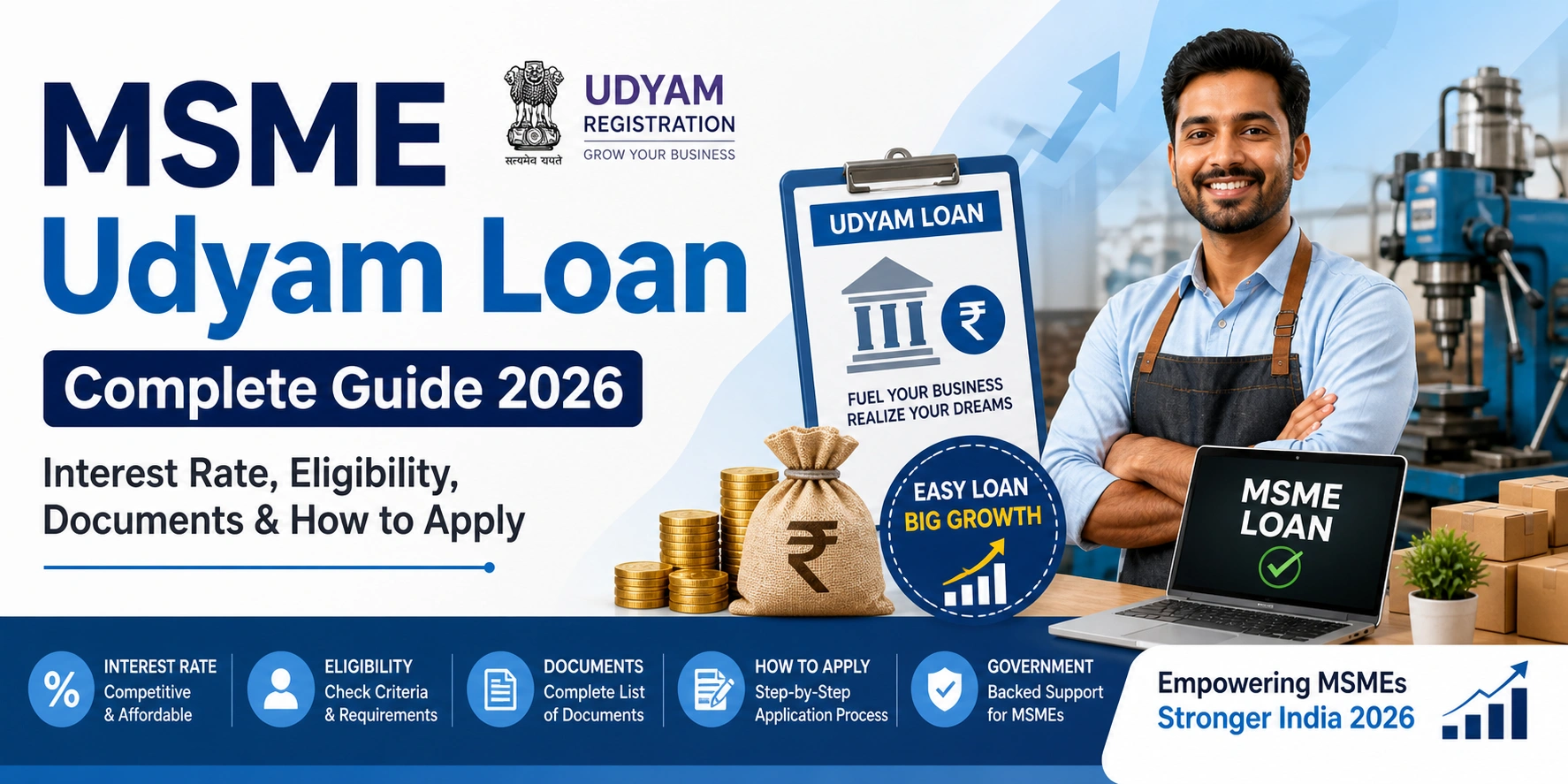
Get the complete MSME Udyam loan guide 2026 — interest rates, eligibility, documents, process, and timeline for new and existing businesses in India.
Know more about MSME Udyam loan interest rates, eligibility, documents, process, and timeline for new and existing businesses in India.
Why Small Business Owners Are Still Struggling to Get Credit
Run a small business in India and you already know the problem. You have orders. You have customers. What you don’t have — at the right time — is money.
That gap between when you need funds and when formal credit arrives has shut down thousands of promising businesses. Yet at the same time, the Government of India has put an enormous financial machinery in place specifically to solve this. MSME loans backed by Udyam Registration are one of the most accessible, affordable, and practical credit tools available to Indian entrepreneurs today.
Whether you’re starting something new or running an existing business that needs capital to grow, this guide covers everything you need to know — interest rates, eligibility, documents required, the actual process, how long it takes, and where to go.
No jargon. No filler. Just what works.
What Is an MSME Udyam Loan?
An MSME loan is a credit facility offered by banks, Non-Banking Financial Companies (NBFCs), and government financial institutions specifically to Micro, Small, and Medium Enterprises. These loans are available at competitive interest rates and, in many cases, without the need for collateral.
The Udyam Registration — introduced by the Ministry of Micro, Small & Medium Enterprises in 2020 — is what officially recognizes your business as an MSME. It replaced the older Udyog Aadhaar system and is now the primary gateway to MSME-linked financial benefits.
Without Udyam Registration, your business simply won’t qualify for most government-backed MSME loan schemes.
MSME Classification in India (2026)
Before applying for any loan, you need to know which category your business falls under. The classification is based on annual investment in plant/machinery and annual turnover:
| Category | Investment Limit | Turnover Limit |
|---|---|---|
| Micro Enterprise | Up to ₹2.5 crore | Up to ₹10 crore |
| Small Enterprise | Up to ₹25 crore | Up to ₹100 crore |
| Medium Enterprise | Up to ₹125 crore | Up to ₹500 crore |
Note: A business must satisfy both the investment and turnover criteria to qualify for a specific category.
Your classification determines which schemes you’re eligible for, how much you can borrow, and what interest rates you’ll get.
MSME Udyam Loan Interest Rates 2026
Interest rates on MSME loans are not fixed across the board — they depend on the lender, your credit profile, and the type of loan. Here’s a practical breakdown:
Public Sector Banks (SBI, Bank of Baroda, PNB, etc.): Interest rates typically start from 7% to 10% per annum under government-backed schemes.
Private Banks (HDFC, ICICI, Axis): Rates generally range from 9% to 14% per annum, depending on business vintage and credit score.
NBFCs (Bajaj Finserv, Tata Capital, IIFL, Shriram Finance): Rates can range from 12% to 24% per annum — higher than banks but approvals are faster and documentation requirements are lighter.
Government-Backed Schemes: Under schemes like CGTMSE and Mudra Yojana, interest rates are subsidized and can go as low as 7% to 8% per annum for eligible borrowers.
What affects your rate?
- CIBIL score (750+ gets the best rates)
- Business age and profitability
- Loan amount and tenure
- Whether you have collateral to offer
- Type of MSME scheme applied under
Who Is Eligible for an MSME Udyam Loan?
For New Businesses (Startups):
You can apply for an MSME loan even if your business is new, but you’ll need to show a solid business plan. Key eligibility criteria:
- Indian citizen aged 21 to 65 years
- Business registered under Udyam Portal
- Valid PAN card and Aadhaar
- Realistic project report and business plan
- Clean credit history (personal CIBIL score matters here)
- Business must be in manufacturing, trading, or service sector
New businesses can access schemes like Mudra Loan (up to ₹20 lakh), PMEGP, and Stand-Up India without needing 2-3 years of financial history.
For Existing Businesses:
Existing MSMEs have more options and typically get better terms. Eligibility usually requires:
- Minimum 1 to 3 years of business operation
- Annual income of at least ₹2 lakh
- Annual turnover of at least ₹10 lakh
- No history of loan defaults
- Valid and updated Udyam Registration
- Good CIBIL score (ideally 700+, best at 750+)
- GST registration (mandatory for most lenders)
Existing businesses can access higher loan amounts — up to ₹5 crore under CGTMSE, and even up to ₹50 crore through SIDBI for larger projects.
Documents Required for MSME Udyam Loan
Having your paperwork ready in advance cuts your processing time significantly. Here’s what most lenders ask for:
Identity and Address Proof:
- Aadhaar card
- PAN card
- Passport, Voter ID, or Driving Licence
- Electricity bill or rent agreement (address proof)
Business Registration Documents:
- Udyam Registration Certificate (mandatory)
- GST Registration Certificate
- Trade licence / Shop Act licence
- Partnership deed or Certificate of Incorporation (if applicable)
Financial Documents:
- Last 2–3 years’ ITR (Income Tax Returns)
- Audited Balance Sheet and Profit & Loss Statement
- Last 6–12 months’ bank statements
- GST returns for last 6–12 months
For New Businesses:
- Detailed Project Report (DPR)
- Projected revenue, expenses, and employment details
- Business plan
Collateral Documents (if applicable):
- Property papers
- Fixed deposit receipts
- Vehicle registration documents
Tip: Keep digital copies ready. Most online platforms accept scanned PDFs, and having everything organized saves you multiple trips to the bank.
MSME Loan Types Available in India
There’s no single “MSME loan.” The category covers several types of credit, each suited to different needs:
1. Working Capital Loan Covers daily operational costs — raw materials, salaries, inventory, rent. These are short-term loans and are among the most commonly used by small businesses.
2. Term Loan Used for buying machinery, equipment, or expanding your facility. Repayment periods range from 1 to 7 years, sometimes up to 15 years for larger projects.
3. Government Scheme Loans
- Mudra Yojana (PMMY): Loans up to ₹20 lakh for micro enterprises under Shishu (up to ₹50,000), Kishore (up to ₹5 lakh), and Tarun (up to ₹20 lakh) categories
- CGTMSE: Collateral-free loans up to ₹5 crore with government credit guarantee
- PMEGP: For new manufacturing or service businesses in rural and urban areas
- Stand-Up India: For SC/ST and women entrepreneurs — loans between ₹10 lakh and ₹1 crore
4. MSME Loan in 59 Minutes The Government of India’s fastest digital loan processing channel — in-principle approval within 59 minutes through the PSB Loans portal (www.psbloansin59minutes.com). Loan amounts range from ₹1 lakh to ₹5 crore.
Step-by-Step Process: How to Apply for an MSME Udyam Loan
Step 1: Complete Your Udyam Registration
Visit udyamregistration.gov.in — the process is free, fully online, and paperless. You’ll need your Aadhaar and PAN. The portal auto-fetches ITR and GST data. You receive your Udyam Registration Certificate with a unique Udyam Registration Number (URN) immediately after submission.
Step 2: Determine the Right Loan Type
Based on your business need — working capital, machinery, expansion — identify which scheme or lender fits best. New businesses should explore Mudra and PMEGP. Existing businesses with 2+ years of history have wider options.
Step 3: Prepare Your Documents
Compile all the documents listed above in digital and physical copies. For new businesses, write a clear, realistic project report covering investment, projected revenue, and how many people you’ll employ.
Step 4: Apply Online or Visit the Branch
- Online: Use Jan Samarth Portal (jansamarth.in), PSB Loans in 59 Minutes, or directly through your bank’s website
- Offline: Walk into any public sector bank branch or NBFC office with your documents
Step 5: Document Verification and Credit Assessment
The lender reviews your application, verifies documents, and assesses your credit score and business viability. You may be called for a personal discussion or site visit.
Step 6: Sanction Letter
On approval, the lender issues a sanction letter with the loan amount, interest rate, tenure, EMI schedule, and terms and conditions. Read this carefully before signing.
Step 7: Loan Disbursal
Once you sign the agreement and complete any required formalities, the loan amount is transferred directly to your bank account.
How Long Does the Process Take?
This is what most borrowers want to know before they start. Here’s a realistic timeline:
| Channel | Approval Time |
|---|---|
| PSB Loans in 59 Minutes Portal | In-principle approval: 59 minutes; full disbursal: 7–10 days |
| Public Sector Banks (offline) | 7 to 15 working days |
| Private Banks | 5 to 10 working days |
| NBFCs | 24 to 72 hours (some same-day disbursals) |
| Government Schemes (PMEGP, Mudra) | 2 to 4 weeks |
The biggest delays happen when documents are incomplete or there are discrepancies between what you submit and what the system shows. Having everything ready and accurate from day one speeds things up considerably.
Where to Apply: Key Portals and Contact Points
- Udyam Registration: udyamregistration.gov.in
- PSB Loans in 59 Minutes: psbloansin59minutes.com
- Jan Samarth Portal: jansamarth.in
- Mudra Loan Application: mudra.org.in or through any bank
- SIDBI (for larger MSME loans): sidbi.in | Helpline: 1800-22-6753
- Ministry of MSME: msme.gov.in | Helpline: 1800-111-955 (toll-free)
- CGTMSE (for collateral-free loans): cgtmse.in
Most public sector banks — SBI, Bank of Baroda, PNB, Canara Bank, Union Bank — are active MSME lenders with dedicated small business loan counters.
Key Benefits of Getting an MSME Udyam Loan
- Collateral-free borrowing up to ₹5 crore under CGTMSE
- Lower interest rates compared to personal loans or informal credit
- Tax benefits and interest subsidies under select government schemes
- Priority processing at banks for Udyam-registered businesses
- Improved credit history that helps you access larger loans in the future
- Access to government tenders and procurement contracts once registered
Practical Tips to Improve Your Loan Approval Chances
1. Get Your Udyam Registration First No Udyam certificate means no access to government schemes. This is step zero.
2. Maintain a CIBIL Score Above 700 Pay existing EMIs and credit card bills on time, every time. A score of 750+ opens the best rates.
3. Keep 12 Months of Bank Statements Clean Lenders look at inflow consistency. Maintain regular business transactions through your current account.
4. File GST Returns on Time GST data is directly linked to your Udyam profile. Missing or delayed returns raise red flags.
5. Prepare a Solid Project Report For new businesses, your project report is everything. Make it specific — actual numbers, realistic revenue projections, a clear plan for repayment.
6. Don’t Apply to Too Many Lenders at Once Each hard inquiry drops your credit score. Research first, then apply to 2–3 suitable lenders selectively.
7. Consider Working with a DSA or Loan Consultant A good Direct Selling Agent (DSA) can match you with the right lender and product, saving time and avoiding rejections. They work on commission paid by the lender — so there’s no cost to you as a borrower.
New Business vs. Existing Business: What’s Different?
| Factor | New Business | Existing Business |
|---|---|---|
| Loan Schemes Available | Mudra, PMEGP, Stand-Up India | All schemes including CGTMSE, term loans |
| Documents Needed | Project report, personal financials | Business financials, GST returns, ITR |
| Max Loan Amount | Up to ₹20–50 lakh (scheme-based) | Up to ₹5 crore+ depending on profile |
| Approval Speed | Moderate (plan scrutiny involved) | Faster (business history available) |
| Collateral Requirement | Usually not required | Optional under CGTMSE |
| Interest Rate | Slightly higher | Lower with track record |
Frequently Asked Questions (FAQs)
1. Is Udyam Registration mandatory to get an MSME loan? Yes, for most government-backed MSME schemes, Udyam Registration is mandatory. It’s free, fully online, and takes less than 30 minutes at udyamregistration.gov.in. Even for bank loans, having Udyam certification significantly improves your approval chances and can qualify you for lower interest rates.
2. Can a new business with no financial history get an MSME loan? Yes. New businesses can apply under Mudra Yojana (up to ₹20 lakh), PMEGP, and Stand-Up India. These schemes are designed for startups and first-time entrepreneurs. You’ll need a detailed project report and clean personal credit history, but financial statements are not required for the smallest loan categories.
3. What is the maximum loan amount under MSME schemes? Under Mudra Yojana, up to ₹20 lakh. Under CGTMSE, collateral-free loans up to ₹5 crore. For SIDBI-backed funding, amounts can go up to ₹50 crore for qualifying medium enterprises.
4. How quickly can I get an MSME loan approved? Through the PSB Loans in 59 Minutes portal, you can get in-principle approval within an hour. Actual disbursal typically takes 7–10 working days. NBFCs can disburse within 24–72 hours in many cases. Government scheme loans take 2–4 weeks due to additional verification.
5. Do I need collateral for an MSME business loan? Not necessarily. The CGTMSE scheme specifically provides a government credit guarantee to lenders so that MSMEs can borrow without pledging property or assets. Many banks offer collateral-free loans up to ₹2 crore for well-qualified MSME borrowers.
6. What CIBIL score do I need for an MSME loan? Most lenders prefer a CIBIL score of 700 or above. A score of 750+ gives you access to the best interest rates. Some NBFCs work with lower scores, but the interest rate will be higher. If your score is below 650, work on improving it before applying.
7. What is the difference between Mudra loan and MSME loan? Mudra loans are a specific government scheme under the Pradhan Mantri Mudra Yojana, designed for micro enterprises and first-time borrowers, with a maximum of ₹20 lakh. MSME loans is a broader category covering all credit products available to Micro, Small, and Medium Enterprises — including working capital loans, term loans, equipment finance, and multiple government schemes including Mudra.
Final Thoughts
The financial support for small businesses in India has never been more structured or accessible than it is right now. Between Udyam Registration, CGTMSE guarantees, the 59-minute loan portal, and competitive lending from both banks and NBFCs, there’s a genuine path to affordable credit for businesses at every stage.
What holds most entrepreneurs back isn’t the lack of schemes — it’s not knowing which door to knock on, not having the paperwork ready, or applying without a clear understanding of what lenders are looking for.
Take the first step: register on the Udyam portal today. That single action unlocks more opportunities than most business owners realize.
If you need help identifying the right MSME loan scheme for your business, or want assistance with the application process, connecting with a local DSA or a certified financial consultant can save you weeks of trial and error — and get funds to your account faster.
Contact for MSME loan guidance:
- Ministry of MSME Helpline: 1800-111-955 (toll-free)
- SIDBI Helpline: 1800-22-6753
- Udyam Portal: udyamregistration.gov.in
- PSB Loans in 59 Minutes: psbloansin59minutes.com
- Jan Samarth Portal: jansamarth.in