The One Government Scheme Every Small Business Owner Should Know About
Starting or growing a business in India is no small feat — especially when the bank asks for collateral you simply don’t have.
If you’ve ever been told “we need property as security” before a bank will even consider your loan application, you’re not alone. Thousands of small business owners across India face this exact wall every single day. A great idea, a solid plan, but no fixed asset to pledge — and suddenly the loan feels out of reach.
That’s exactly the problem the CGTMSE scheme was built to solve.
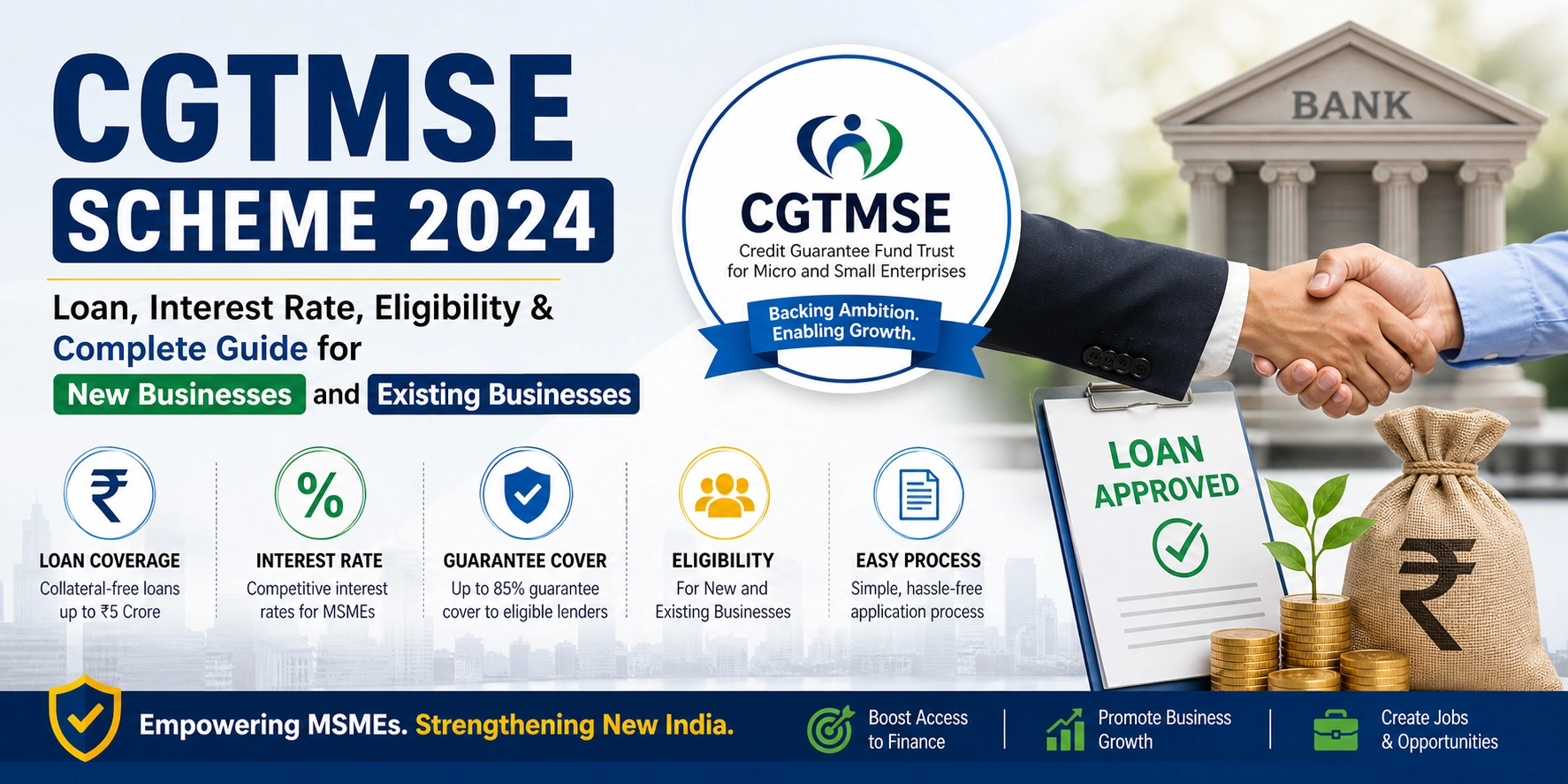
The Credit Guarantee Fund Trust for Micro and Small Enterprises — CGTMSE — is a government-backed scheme that allows banks and NBFCs to give collateral-free loans to small businesses. The government essentially acts as your guarantor. No land. No property. No gold pledge.
Whether you’re launching a new venture or trying to scale an existing one, this guide breaks down everything you need to know — the loan amount, interest rate, eligibility, documents, process, and how long it actually takes.
What Is the CGTMSE Scheme?
The CGTMSE scheme was launched in 2000 by the Ministry of MSME and SIDBI (Small Industries Development Bank of India). The trust provides credit guarantees to lending institutions so they feel confident giving loans to micro and small enterprises — even without collateral.
Think of it this way: when a bank gives you a loan under CGTMSE, the trust covers a portion of the loss if you default. This removes the biggest risk for the lender, which makes them more willing to lend to small businesses.
Who manages it?
The Credit Guarantee Fund Trust for Micro and Small Enterprises (CGTMSE) is jointly set up by the Government of India and SIDBI.
What’s the core purpose?
To make credit accessible for MSMEs that lack physical assets to offer as security — which includes most first-generation entrepreneurs and small shop owners.
CGTMSE Loan Amount — How Much Can You Get?
One of the biggest questions business owners ask is: how much loan can I actually get under CGTMSE?
Here’s the current structure:
| Category | Maximum Loan Amount |
|---|
| Micro Enterprises | Up to ₹5 lakh (enhanced coverage) |
| Small Enterprises | Up to ₹2 crore |
| Women Entrepreneurs / NE Region / Aspirational Districts | Up to ₹2 crore (with higher guarantee cover) |
| Retail Trade | Up to ₹1 crore |
| Startups (under Startup India) | Up to ₹5 crore |
As of recent updates, the CGTMSE maximum loan limit has been enhanced to ₹5 crore for eligible cases. This is a major upgrade from the earlier ₹2 crore cap and opens the door for many growing MSMEs.
The loan can be used for:
- Working capital requirements
- Purchase of machinery and equipment
- Business expansion
- Raw material procurement
- Setting up a new unit
CGTMSE Interest Rate — What Will You Pay?
The CGTMSE scheme itself does not set a fixed interest rate. The interest rate is decided by the lending bank or financial institution based on your credit profile, business type, and loan amount.
Typical interest rate range: 8% to 14% per annum (varies by lender)
However, there’s a guarantee fee that the bank pays to CGTMSE, which is often partially or fully passed on to the borrower. This fee is called the Annual Guarantee Fee (AGF) and typically ranges from 0.37% to 1.35% of the loan amount per year depending on the loan size and category.
Some states and government programs also offer interest subvention (subsidy) on CGTMSE loans, so the effective rate you pay can be lower.
Quick tip: Always compare rates across at least 3-4 banks before finalizing. PSU banks like SBI, Bank of Baroda, and Canara Bank tend to offer more competitive rates under government schemes.
CGTMSE Eligibility — Who Can Apply?
This is where most people get confused. Let’s keep it simple.
New Businesses (Startups / New Ventures)
- The business must be registered as a Micro or Small Enterprise under the MSME/Udyam Registration
- The business must not have started commercial operations yet, or have recently started
- Promoter should have a clean credit history (no defaults, no NPA record)
- The project should be commercially viable
Existing Businesses
- Must be registered under Udyam Registration (formerly MSME registration)
- Should be classified as Micro or Small enterprise based on turnover/investment norms
- Business should be operational and generating revenue
- No existing default with any bank or NBFC
- Last 2-3 years of financial statements may be required
Who is NOT eligible?
- Medium and Large enterprises (CGTMSE covers only Micro and Small)
- Retail traders (limited coverage up to ₹1 crore)
- Businesses in agriculture/farming (separate schemes apply)
- Businesses with existing NPAs or loan defaults
Documents Required for CGTMSE Loan
Getting your paperwork right saves weeks of back-and-forth. Here’s what you’ll typically need:
For the Borrower (Individual/Proprietor/Partner/Director):
- Aadhaar card and PAN card
- Passport-size photographs
- Residence proof (utility bill, rent agreement)
- Educational qualifications (if applicable)
For the Business:
- Udyam Registration Certificate (MSME registration)
- GST registration certificate
- Business address proof (rent deed, electricity bill)
- Bank account statements (last 12 months)
- ITR (Income Tax Returns) — last 2-3 years for existing businesses
- Balance sheet and P&L statement (for existing businesses)
- Business plan / project report (especially for new businesses)
- Quotations for machinery/equipment (if applicable)
For the Loan Application:
- Duly filled loan application form of the respective bank
- Business plan with projected financials
- Details of promoters and their background
One document that trips up many applicants — the project report for new businesses. This should include your market analysis, product/service details, investment plan, and financial projections for at least 3 years. If you’re not sure how to write one, many bank branches and MSME DFOs (Development Facilitation Officers) can help.
CGTMSE Loan Process — Step by Step
Here is exactly how the process works from application to disbursement:
Step 1: Get Your Udyam Registration
Before anything else, register your business at udyamregistration.gov.in. This is free and takes less than 30 minutes if your Aadhaar and PAN are ready.
Step 2: Choose Your Lending Institution
CGTMSE works with over 130 registered Member Lending Institutions (MLIs) including SBI, Punjab National Bank, Bank of Baroda, HDFC Bank, Bajaj Finserv, SIDBI, and several others. Choose based on your existing banking relationship and interest rate offered.
Step 3: Prepare Your Documents and Business Plan
Compile all the documents listed above. For new businesses, the project report is critical — treat it seriously.
Step 4: Submit Loan Application
Submit the application at the bank branch or through the bank’s online portal. Many banks now allow MSME loan applications through their mobile apps or websites.
Step 5: Bank Appraisal and Credit Assessment
The bank will evaluate your application, run a credit check (CIBIL/CRIF), assess your business plan, and decide the loan amount and terms.
Step 6: Bank Applies for CGTMSE Guarantee
Once the bank sanctions your loan, they register the case with CGTMSE’s online portal and pay the Annual Guarantee Fee. You don’t have to do this part — the bank handles it directly.
Step 7: Loan Disbursement
After CGTMSE approves the guarantee, the bank disburses the loan to your account.
How Long Does the Process Take?
This is one of the most searched questions — and honestly, the answer depends on how prepared you are.
- Udyam Registration: 1 day
- Bank appraisal and sanction: 7 to 30 days (varies by bank and loan amount)
- CGTMSE guarantee approval: 3 to 7 working days (done online by the bank)
- Disbursement after sanction: 1 to 5 working days
Total timeline: Realistically, 3 to 6 weeks from application to disbursement if all documents are in order.
Delays usually happen when documents are incomplete, the project report is weak, or the bank’s credit team has a backlog. Being proactive — following up every few days — genuinely helps move things faster.
What Does CGTMSE Actually Cover?
The guarantee cover is the core value of the scheme. Here’s how it breaks down:
| Category | Guarantee Cover |
|---|
| Loans up to ₹5 lakh (Micro) | 85% of loan amount |
| Women/NE/SC/ST/Aspirational Districts | 85% coverage |
| All other eligible borrowers | 75% of loan amount |
| Above ₹50 lakh up to ₹2 crore | 50% of loan amount |
This means if you default on a ₹10 lakh loan and you fall under the 75% coverage category, CGTMSE pays ₹7.5 lakh to the bank. The bank only loses ₹2.5 lakh — which is why they’re willing to lend without asking for your house as security.
CGTMSE for New Business vs Existing Business
New Businesses:
The scheme is available right from day one. You don’t need years of financials. A solid project report, your Udyam registration, and clean personal credit history are the three pillars of a successful application.
Banks will look hard at your business plan. Be specific — vague plans like “I will sell groceries” don’t work. Show market demand, pricing, expected revenue, and break-even period.
Existing Businesses:
You have an advantage — you can show actual revenue, GST returns, and bank statement inflows. This makes the bank’s job easier and improves your chances of getting a higher loan amount.
If your business is already registered and has 2+ years of operations, apply for the enhanced CGTMSE limit rather than settling for a small working capital loan.
CGTMSE Contact Details and How to Reach Them
CGTMSE Head Office:
Credit Guarantee Fund Trust for Micro and Small Enterprises
The Arcade, World Trade Centre, Cuffe Parade, Mumbai – 400 005
Phone: 022-22163900
Email: cgtmse@sidbi.in
Website: www.cgtmse.in
For loan applications, always approach your nearest branch of a CGTMSE Member Lending Institution. You can check the list of all MLIs on the CGTMSE website.
SIDBI Regional Offices (for MSME support and guidance):
- Delhi, Mumbai, Chennai, Kolkata, Ahmedabad, Pune, Hyderabad, Bengaluru, Lucknow, and 15+ other cities
Tips to Improve Your CGTMSE Loan Approval Chances
These are practical points that experienced MSME borrowers swear by:
1. Get your Udyam Certificate first — always.
Banks won’t even entertain a CGTMSE application without it.
2. Maintain a CIBIL score above 700.
Your personal credit score matters even for business loans, especially for new ventures.
3. Invest in a proper project report.
Hire a CA or MSME consultant if needed. A ₹3,000 project report can unlock a ₹20 lakh loan.
4. Open a current account with the lending bank first.
Operating a current account for 6+ months creates a relationship and makes the bank more confident.
5. Apply to PSU banks for better rates.
Government banks like SBI and Bank of Baroda are more aligned with government schemes and process CGTMSE cases regularly.
6. Don’t apply to multiple banks simultaneously.
Multiple hard enquiries on your CIBIL report in a short period reduce your score and raise red flags.
Frequently Asked Questions (FAQs)
Q1. Can a new business with no revenue apply for a CGTMSE loan?
Yes. New businesses without operational history can apply. The key requirements are Udyam registration, a detailed project report, and a clean personal credit score of the promoter. Many banks sanction CGTMSE loans for startups based entirely on the business plan.
Q2. Is there any subsidy on the CGTMSE loan interest rate?
CGTMSE itself does not offer interest subvention. However, several state governments and central schemes like PMEGP (Prime Minister’s Employment Generation Programme) offer interest subsidies when combined with CGTMSE guarantee cover. Check with your district MSME office for state-specific benefits.
Q3. What is the maximum loan I can get under the CGTMSE scheme?
As per the latest updates, the maximum loan under CGTMSE has been enhanced to ₹5 crore for eligible MSMEs. For retail trade, the cap is ₹1 crore. Standard small enterprise loans are covered up to ₹2 crore.
Q4. How long is the CGTMSE guarantee valid?
The guarantee is valid for the loan tenure — typically up to 5 years for term loans and 1 year (renewable) for working capital loans.
Q5. Can I get a CGTMSE loan if I already have another business loan?
Yes, you can — as long as your existing loan is being repaid on time and you don’t have any NPA account. The bank will assess your total debt obligations and repayment capacity before sanctioning a new CGTMSE loan.
Q6. Which banks offer CGTMSE loans easily?
SBI, Bank of Baroda, Punjab National Bank, Canara Bank, and SIDBI are among the most active lenders under CGTMSE. Among private and NBFCs, Bajaj Finserv and Tata Capital also participate in the scheme.
Q7. What happens if I can’t repay the CGTMSE loan?
The bank initiates recovery proceedings. If recovery fails, the bank claims the guarantee from CGTMSE. Your personal and business credit score will be severely impacted, and future loans become very difficult to obtain. Always borrow what you can realistically repay.
Conclusion: The CGTMSE Scheme Is One of the Best Tools for Indian MSMEs — Use It Right
The CGTMSE scheme is genuinely one of the most powerful financial tools available for small business owners in India. It removes the biggest barrier to credit — collateral — and gives genuine entrepreneurs a fighting chance.
But the scheme only works when you approach it correctly. Get your Udyam registration done. Keep your credit score clean. Build a serious project report. Choose the right lender. And follow up consistently.
If you’re a new business owner, don’t wait until you have property to offer. The CGTMSE scheme was literally designed for people in your position.
If you’re running an existing business and need capital to grow, this scheme can get you up to ₹5 crore without pledging your assets.
Take the first step today — visit your nearest CGTMSE member bank, or reach out to a local MSME consultant or CA who can guide you through the application process. The funds you need to grow your business may be closer than you think.
Keywords naturally used: CGTMSE scheme, CGTMSE loan, CGTMSE eligibility, CGTMSE interest rate, CGTMSE documents, MSME loan without collateral, Udyam registration loan, collateral-free business loan India, CGTMSE process, CGTMSE coverage, CGTMSE new business, CGTMSE existing business, SIDBI MSME loan, credit guarantee scheme India