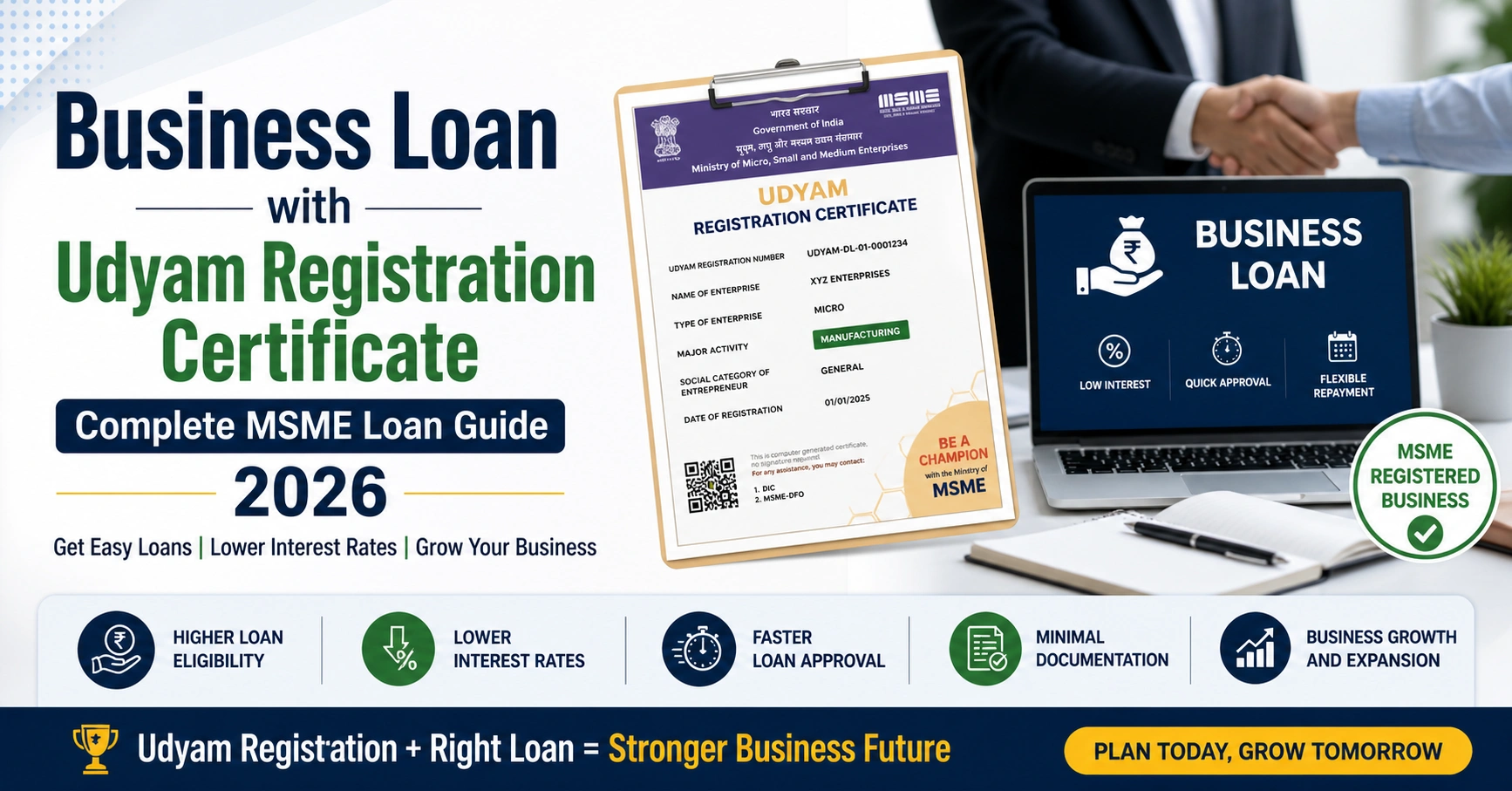
Want a business loan with your Udyam Registration Certificate? Learn the step-by-step process, documents needed, top lenders, and tips to get approved fast in 2026.
Get a Business Loan with Udyam Registration Certificate — Complete MSME Loan Guide 2026
Your Udyam Certificate Is Worth More Than You Think
Most small business owners in India register on the Udyam portal, download their certificate, and file it away — never realising it is sitting on potential cash they could be using right now.
That one piece of digital paper — your Udyam Registration Certificate — is your gateway to business loans with lower interest rates, minimal collateral requirements, and priority access under government schemes. Banks are literally required by the Reserve Bank of India to lend to registered MSMEs under Priority Sector Lending norms.
If you have been struggling to understand how to leverage your MSME status to get a business loan, this guide lays out everything — from eligibility and documents to the exact steps banks follow, realistic timelines, and which lenders are best suited for your business size and type.
Let’s get into it.
What Is the Udyam Registration Certificate, and Why Do Banks Care About It?
The Udyam Registration Certificate is an official, government-issued digital document issued by the Ministry of Micro, Small and Medium Enterprises (MSME). It replaced the older Udyog Aadhaar system and assigns every registered business a unique 19-digit Udyam Registration Number (URN) along with a QR code for instant verification.
When a business holds this certificate, it is formally classified as a Micro, Small, or Medium Enterprise. This classification matters enormously in the banking world because:
- Banks must meet Priority Sector Lending (PSL) targets, and MSME loans count toward them
- Registered MSMEs become eligible for government-backed credit guarantee schemes that remove the need for collateral
- Lenders view Udyam-registered businesses as lower risk — the government has already done a basic verification of your PAN, Aadhaar, and turnover data
In short, your Udyam certificate signals to a bank that you are a legitimate, verified business — and that changes the entire conversation around loan eligibility.
MSME Classification: Which Category Does Your Business Fall Under?
Before applying for a business loan, you need to know where your business sits in the MSME classification framework, updated with effect from April 1, 2025.
| Category | Investment in Plant & Machinery | Annual Turnover |
|---|---|---|
| Micro | Up to ₹2.5 crore | Up to ₹10 crore |
| Small | Up to ₹25 crore | Up to ₹100 crore |
| Medium | Up to ₹125 crore | Up to ₹500 crore |
Your category determines which specific schemes you can access and the maximum loan amounts available under guaranteed credit programs. A Micro enterprise, for instance, can access collateral-free loans of up to ₹1 crore under the Credit Guarantee Fund Trust for Micro and Small Enterprises (CGTMSE) scheme.
How a Business Loan with Udyam Registration Certificate Works
This is where most guides get vague. Let’s be specific.
When you apply for an MSME business loan using your Udyam Certificate, the bank or NBFC uses it to:
- Confirm your MSME status — This places your application in the MSME lending category, which has different (often more favourable) processing norms than regular business loans.
- Check scheme eligibility — Government-backed schemes like CGTMSE, Mudra, and Stand-Up India all require Udyam registration as a prerequisite.
- Assess your turnover and investment data — The portal is linked to your PAN and GST, so the financials you declared are cross-verified automatically.
- Classify the loan for reporting — Banks need to report MSME lending separately to the RBI. Your certificate helps them do that correctly.
A common misconception is that holding a Udyam Certificate guarantees loan approval. It doesn’t. But it significantly improves your eligibility, unlocks better terms, and reduces the collateral burden — three things that make a real difference.
Documents Required for a Business Loan with Udyam Certificate
The exact list can vary between lenders, but here is a standard checklist that covers most banks and NBFCs:
Identity and Address Proof:
- Aadhaar card
- PAN card
- Passport or Voter ID (for address)
Business Registration Documents:
- Udyam Registration Certificate (mandatory for MSME schemes)
- GST registration certificate
- Business registration certificate (if applicable — Shop Act, Partnership Deed, MoA, etc.)
Financial Documents:
- Last 2–3 years of ITR with computation
- Balance sheet and profit & loss statement (CA certified for most banks)
- Last 6–12 months of bank statements
Loan-Specific Documents:
- Loan application form
- Business plan or project report (required for new units or term loans above ₹25 lakh)
- Quotation of machinery or equipment (for equipment finance)
For Collateral-Based Loans (if applicable):
- Property documents, title deed
- Valuation report
The good news for Udyam-registered businesses applying under CGTMSE: collateral documents may not be required at all for loans up to ₹1 crore for Micro and Small enterprises.
Step-by-Step Process to Get a Business Loan Using Your Udyam Certificate
Here is the actual process, from start to disbursal:
Step 1: Confirm Your Udyam Registration Is Active
Log in to udyamregistration.gov.in and verify your certificate is current and reflects accurate turnover and investment data. An outdated or incorrect certificate can cause delays.
Step 2: Choose the Right Loan Type and Scheme
Decide which kind of funding you need:
- Working capital loan — for day-to-day operations, stock purchase, payroll
- Term loan — for machinery, equipment, or business expansion
- Mudra loan — for micro businesses needing up to ₹20 lakh (Shishu, Kishore, Tarun tiers)
- CGTMSE-backed loan — collateral-free loans up to ₹5 crore for eligible MSMEs
- Emergency Credit Line or other government-backed schemes
Step 3: Approach the Right Lender
Match your business profile to the right institution:
- SBI, Bank of Baroda, PNB — best for established businesses with 2+ years of ITR
- HDFC Bank, ICICI Bank, Axis Bank — faster processing, good for small and medium enterprises
- Bajaj Finserv, Tata Capital, IIFL Finance — good for newer businesses or those with lower CIBIL scores
- SIDBI (Small Industries Development Bank of India) — specialised MSME lender with refinance and direct lending programs
Step 4: Submit Your Application and Documents
Most lenders now offer online application portals. Upload your Udyam certificate along with the standard document checklist. For PSU banks, a branch visit is usually still required for the first application.
Step 5: Bank Assessment and Verification
The lender verifies your documents, runs a CIBIL check, and may send a field officer for a business visit. For loans under ₹10 lakh, many banks now complete this digitally.
Step 6: Sanction and Disbursal
Once approved, you receive a sanction letter with loan amount, interest rate, tenure, and EMI. Disbursal usually happens within 3–7 working days for NBFCs and 7–21 days for public sector banks.
Realistic Timelines: How Long Does It Actually Take?
| Lender Type | Approval Time | Disbursal After Approval |
|---|---|---|
| NBFCs (Bajaj, IIFL, Tata) | 24–72 hours | 1–3 days |
| Private Banks (HDFC, ICICI) | 3–7 days | 2–5 days |
| PSU Banks (SBI, PNB) | 7–21 days | 5–10 days |
| SIDBI | 15–30 days | 7–14 days |
For urgent working capital needs, NBFCs are faster but charge slightly higher interest. For lower rates and larger amounts, PSU banks and SIDBI are worth the wait.
Key Benefits of Getting a Business Loan with Udyam Registration
1. Collateral-Free Credit Under CGTMSE, Udyam-registered Micro and Small enterprises can access loans up to ₹5 crore without pledging property. This is a significant advantage for businesses that have not yet built up significant assets.
2. Lower Interest Rates Udyam-registered businesses typically access credit at 1–1.5% lower than standard market rates through priority sector channels. PSU banks also offer special MSME rate cards that are not available to non-registered businesses.
3. Mudra Loan Access The Pradhan Mantri Mudra Yojana (PMMY) is available only to MSME-classified businesses. Loans range from ₹50,000 (Shishu) to ₹20 lakh (Tarun), with minimal documentation and zero collateral.
4. Faster Processing Banks have dedicated MSME loan desks, and applications with a valid Udyam certificate move faster through the system because the government has already pre-verified your business details.
5. Government Tender Access While not directly linked to loans, Udyam registration also opens access to government procurement tenders — which can improve your revenue visibility and make you a stronger loan applicant.
Common Reasons MSME Loan Applications Get Rejected
Even with a Udyam Certificate, your loan can be rejected. The most common reasons:
- Low CIBIL score (below 700 is considered risky by most lenders)
- Insufficient ITR — less than 2 years of filed returns
- High existing debt — debt-to-income ratio above 50%
- Mismatch in declared turnover — what’s on Udyam doesn’t match GST or ITR
- No GST registration — many lenders treat GST as a basic requirement even when not legally mandatory
- Incomplete documentation — missing bank statements or unsigned forms
The fix for most of these is preparation. Talk to your CA before applying. Clean up mismatches. File ITR on time. And if your CIBIL is low, spend 6 months improving it before applying to a bank — try an NBFC first in the meantime.
Practical Tips to Improve Your Chances of Loan Approval
Keep your Udyam certificate updated. If your turnover or investment details have changed significantly, update them on the portal. Banks cross-verify this with GST data.
Maintain a healthy current account. Your bank statement is often the most important document in the assessment. Regular credits, decent average balance, and no cheque bounces make a strong case.
File ITR every year, even if you’re below the threshold. It creates a paper trail of your business income that banks trust.
Start small if you’re new. A Mudra Shishu loan of ₹50,000 or a Kishore loan of ₹5 lakh — repaid on time — builds your credit profile for a larger application later.
Consider a relationship-based approach. Walk into the bank where you have your current account and speak to the MSME loan officer directly. A branch manager recommendation still carries significant weight in PSU banks.
Prepare a simple one-page business summary. It’s not required for small loans, but for anything above ₹25 lakh, having a brief document explaining what your business does, your major customers, and how you plan to use the funds can make the assessment faster and more favourable.
Contact Details and Official Resources
- Udyam Registration Portal: udyamregistration.gov.in
- MSME Ministry Helpline: 1800-111-955 (toll-free)
- SIDBI (for MSME-specific lending): sidbi.in | 1800-226-753
- CGTMSE (Credit Guarantee Scheme): cgtmse.in
- Mudra Loan (PMMY): mudra.org.in
- MSME Sampark (for scheme grievances): msmesampark.gov.in
For loan applications, you can also visit your nearest PSU bank branch (SBI, Bank of Baroda, Canara Bank) or apply directly through the digital portals of Bajaj Finserv, Tata Capital, or IIFL Finance for faster turnaround.
FAQ: Business Loan with Udyam Registration Certificate
1. Is Udyam Registration mandatory to get a business loan in India?
It is not legally mandatory for all business loans, but it is required for MSME-specific schemes like CGTMSE, Mudra, and priority sector lending. Without it, you may still get a loan, but you will miss out on lower rates, collateral waivers, and government-backed guarantees. For any serious MSME loan, register first.
2. How long does it take to get the Udyam Registration Certificate?
The registration is instant and completely free on udyamregistration.gov.in. Once you submit your Aadhaar OTP and PAN details, the certificate is issued immediately and sent to your registered email address.
3. Can I get a collateral-free MSME business loan with my Udyam certificate?
Yes. Under the CGTMSE scheme, Micro and Small enterprises with Udyam registration can access collateral-free loans of up to ₹5 crore through participating banks and NBFCs. The government provides the guarantee, removing the need for you to pledge property.
4. What is the maximum loan amount I can get with Udyam Registration?
This depends on your category and the lending program. Mudra loans go up to ₹20 lakh. CGTMSE-backed collateral-free loans go up to ₹5 crore. For larger amounts, banks consider turnover, CIBIL, and security. Some banks offer Udyam-registered businesses loans of ₹10 crore or more under their MSME term loan products.
5. Which bank is best for MSME business loans in India?
For first-time borrowers or small amounts, SBI’s Mudra loan or SIDBI’s direct lending programs are good starting points. For faster processing, HDFC Bank and Axis Bank have strong MSME lending desks. NBFCs like Bajaj Finserv and IIFL Finance are best when speed is the priority. The “best” lender depends on your loan amount, urgency, and CIBIL score.
6. Does the Udyam certificate have an expiry date?
No, the Udyam Registration Certificate has lifetime validity as long as your business remains within MSME classification limits. However, your turnover and investment data must be updated annually on the portal to ensure accuracy and continued eligibility for schemes.
7. Can a startup or new business get a loan using Udyam Registration?
Yes, but with some limitations. Most banks require at least 1–2 years of ITR. For brand-new businesses, the Mudra Shishu loan (up to ₹50,000) or Tarun tier (up to ₹20 lakh) is the most accessible option. Startup India-linked loans and state government schemes also cater specifically to early-stage businesses with Udyam registration.
Closing: Your Udyam Certificate Is Not Just a Document
Think of your Udyam Registration Certificate as a key — one that most small business owners in India own but never actually use to open the right doors.
India has over 6 crore registered MSMEs. The government has built an entire financial ecosystem — from Mudra to CGTMSE to priority sector mandates — specifically to push credit toward businesses like yours. The only thing standing between you and that capital is knowing how to navigate the process.
Update your Udyam details. Get your ITR in order. Approach the right lender with the right documents. And use the official helplines and portals whenever you are stuck — that is what they are there for.
If you are a loan consultant or DSA helping business clients, this is also your edge: understand this ecosystem better than your competitors, and you become indispensable to every MSME that walks through your door.
The opportunity is real. The framework is in place. Now it is just a matter of taking the first step.
For any queries related to Udyam Registration or MSME loan applications, contact the MSME Ministry Helpline at 1800-111-955 (toll-free) or visit udyamregistration.gov.in.